Thursday, 21 May 2015

Polaroids/Fashion Documentary


(Polaroids taken my Myself)

      Further on from my shoot, I wanted to document it by using different mediums such as other forms of photography and a film as you can see below. Using polaroids gave me the opportunity to develop a story/journey towards the end of my Final Major Project (FMP) and the transition of minimalist perspective on the human form (the models), going into clear vision of their surroundings and then black, which represents the death of them from Alzheimer's disease. In addition to this, polaroids in general add a nice touch to any project as it shows the backing work towards my shoot; the polaroids above were taking during the white background shoot. Moreover, polaroid images have a much more faded look to them as oppose to a high mega-pixeled camera which I used for my main shoot. 

     Below is a short film documentary I made using iMovie. Making a film was a good way to develop and show my work in a more efficient way by making my project look even more realistic. Furthermore, I wanted the film to look more so like a documentary as oppose to a quick fashion film because the whole reason I wanted to research "Living with Dementia" was due to watching a documentary on Dementia prior to this. The film is short and predominantly focuses on my models whilst they pose, but also get into character with themselves as patients with dementia, seeing themselves as their younger beings. Plus, I had help from my friend, Kerenza Quayum who helped film quick shots whilst I was taking the photographs of the models. I also captured my own videos which I felt would make this video much more structured and relevant for my theme. 

      Once the video was being constructed, it was time for me to find a song I felt would fit my project nicely and this being 'Love Lust' by King Charles. From this song, I looked up the lyrics and the line that proved success to me was, "Oh, lust only grows like anger and revenge or beauty comes and goes but love stays until the end". I felt that this song would be great to go alongside my theme because with Dementia, it is agreeable and completely understandable that people do become very infuriated that they forget their own memories or even their loved ones who are devastated that they do not remember theirs. Although, the positive part within this quote is that no matter if you lose your memories or start to lose yourself for that matter, the ones who love you most will always be by your side and never let you go. It is key to note that the film slides were also edited to fit the theme and I did this by adding a 'vintage' layer on top of the video to go back to the idea of representing the models as dementia patients' younger selves.  Overall, I am very happy with my fashion film which is actually the first one I have ever made, hence I feel that this will show that I am a keen fashion student who wants to try experiment with every kind of process as much as possible so that I can get the best grade. Despite this, I would have liked more help developing this film from either the tutors or from my own approach, but unfortunately I was running out of time to do so and I wanted the film to be as greatly effective as possible. Not only this, but I really like how my polaroids came out for this process, although it would have been better if I took more of them to explain my FMP journey further. 


(Fashion Documentary produced by Myself)


Wednesday, 20 May 2015

Photo Shoot Edits (Photoshop)


(Photography and edits produced by Myself)

I can't express how pleased I am with this shoot, it definitely matches the standards or perhaps even surpasses the photography I have done throughout this course or ever! The hardest part about getting this shoot to come together was finding the location to hold it in. This was due to myself on a personal level from not having any grandparents to use their living rooms, not to mention I don't really know many elderly people and the ones that I do know of tend to have renovations and modern approaches to their homes. In addition to this, I tried to ask my friends if their grandparents had any sort of similar location but the majority said no and others felt that it was slightly intrusive, which I completely understand! Nonetheless, I hit my pot of gold and had this living room set which contained many antique items such as old photographs, porcelain objects, antique coffee tables, tea sets and much more. If it wasn't for this location, my shoot would have probably been no where near as good if say I was to just go to a furniture shop or antique shop.

   The models within the photographs were great, the both managed to relax and get into role very quickly post the shoot we did earlier on at Ravensbourne. In terms of the models' appearances, the short hair really does escalate the elderly perspective further, with minimal makeup and the cliche old women that go round to each others houses, sit around, drink tea, smoke and gossip. This encouraged me to take advantage of the objects within the room such as newspapers, tea cups, ash trays and more to really get that sense of an elderly person or any general person in their home. Considering that there were 2 models in my shoot, it made it much easier for me to show the bond between the two, but also the loss of each other at the same time. One of my top favourite images would be the one where they're both looking into the mirror of themselves as if they have to have some sort of reassurance to remember themselves. My shoot also involved a lot of gentle touching with hands, hips and general places to show the attachment to the person you love/had loved.


(Photography and edits produced by Myself)

     When I was editing the shoot on Photoshop, I wanted to add a faded tint to the images to make them look vaguely vintage and I think this came across very successfully. If I could have done anything differently, I would have liked to have experimented with the photos such as collaging, burning, shredding and much more, similarly to what I did earlier in my project for research and experimentation. If I have time, then I may see if I can get around to doing those processes and experimentations. In addition to this, I had a friend take several recordings of the models and shoot during my time photographing them and I hope to make a quick fashion documentary representing this photo shoot to add even more perspective to my work and theme for my Final Major Project (FMP). Furthermore, I plan on going out of my sketchbook and creating a board of final images and the concept ideas I had going towards final designs and ideas for the shoot to show my journey and development coming towards this point of the project.

   The next stage of this project will be fully finalising the overall look of the final shoot photographs and then selecting a final 3 images to have as the official final images. This will make my work look more focused upon and have a professional approach as I don't want to confuse the viewers and their perspective with too many. From this, I expect these images to be shown within my exhibition space along with my 2 garments, sketchbooks and perhaps even my fashion documentary, depending on how well processed it is and how much time I have to work with it. It has come to my attention that there is practically no more time to work on anything in such a great detail and it is rather sad that we are coming to the end of an amazing year, but as a fashion student, I feel that I have drastically come out of my comfort zone since the start of this course and really challenged myself to get the best results for my FMP.

Shoot Research


      Above is examples of some research I produced prior to my photo shoot. I began by researching a photographer called Tom Hussey; he did a series of photos which was focused upon the idea of dementia and how it impacts them emotionally. In addition to this, I was particularly interested and fascinated by the way Hussey managed to reflect the dementia patients younger self through the mirror and it would be interesting if I could find a way to reflect back to this as inspiration by using a mirror or perhaps working on photoshop to double the image. 

     "Yet the underlying message is much more painful as a reflection of a mentally debilitating disease five million men and women in the United States currently suffer from. The photographs ran as an ad for an Alzheimer’s pharmaceutical patch - seen on many of the model's arms - aiming to help those suffering from dementia, a disease that gradually strips its victims of its more recent memories… ‘We worked through the casting and location aspects of the ads helping to determine what profession the patient had been in their youth so we could portray that in the reflected image,’ he said of the photos’ creation. ‘This profession drove what room setting and propping needed to be created to complete the image.’ In result, a seamstress sees herself seated before a sewing machine. In another photo a welder holds his old mask while turning to see himself in his much younger years, the mask clipped securely around his head. In some of the staged photos actual pictures of the models are seen tucked into the setting, showing them how they used to look, Mr Hussey said."

www.dailymail.co.uk

    The overall setting I want for my photo shoot is to be in a rather antique, old 70's living room, yet I want to enhance the elderly vibes with crystal vases, porcelain plates, objects and cups. Ideally, I would like to have some floral highlights throughout the room as the stereotype of your grandparents house tends to be very busy, yet weirdly cosy at the same time and I want my models to look as relaxed as possible. Considering I have two models, it plays greatly to my advantage as I get to experiment with them both gently touching each others hands or going back to back to reflect back to Hussey's mirror interpretation to dementia. 


        Not only did I have to focus on the poses and setting for the photoshoot, I also have to have a look book for how I want my models to be presented. Due to my FMP being "Living with Dementia", I want to relate back to Hussey's work and use 2 models who look fairly identical to each other to portray one being a normal, healthy person and the other distraught by dementia. Although with the mirror idea, it would be interesting to have them portray their younger selves in person which will be most likely the storyline I will use. For the models, I want them to be slim and probably more slim than most models to really enhance the eery, vintage look to the images. In addition to this, whilst I was doing my research earlier during my FMP, their was evidence to suggest that many people with dementia tend to lose a lot of weight and some even make themselves paralysed from their lack of movement and exercise. Not to mention, I want both models to have short hair, which relates back to my illustrations as I feel this will enhance the identical perspective even more and this will be in a small, black/brown bob either with bangs or not. In regards to makeup, I want it to be practically minimal, as if you can't tell at all and this is because I want it to relate back to the models being their younger selves, although you don't see many elderly people wearing makeup and I want the storyline to be as realistic as possible. 

    Overall, I feel very confident to start my photo shoot and I already have two girls in mind that I want to use for my shoot. The hardest challenge will be to find a location to shoot this in as I don't have any grandparents and it would be rather strange to ask a student to use her grandparents living room and that is even if it fits in with the overall atmosphere I want for my shoot! Not only this, but I need to make sure my models will fit into the clothes perfectly without any faults, although I must come prepared if alterations are needed. Nonetheless, I am very excited for the outcome as I am already extremely pleased with how my garments came out, so I hope my photo shoot will do the same. In addition to this, we are also having my garments shot at Ravensbourne and I will not be taking the photographs, so it will be interesting to see how someone will capture the look of my clothes, but also what they think or feel towards the garments.

Tuesday, 19 May 2015

Ravensbourne Photo Shoot w. Details


(Garments constructed by Myself, Photographs taken by Photography Student)
Models: Mia Ryder/ Briony Mitchel

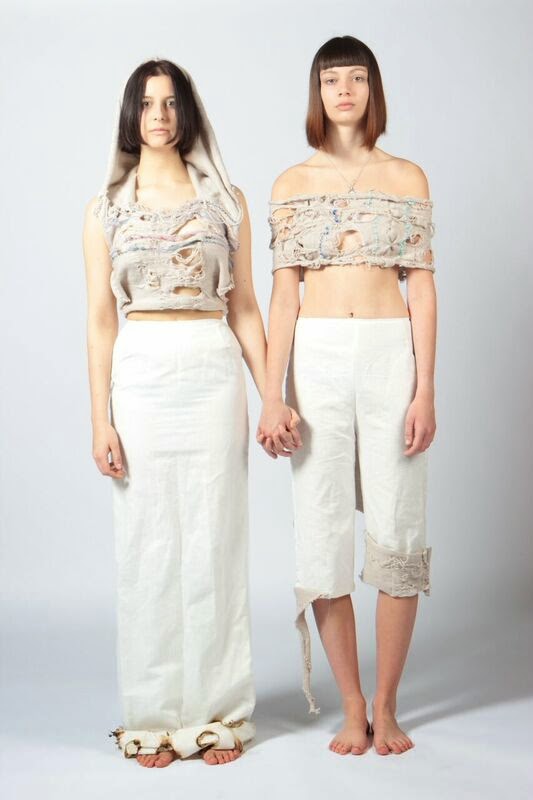
      I am ecstatic with the results I managed to achieve from both my garment construction and models. Admittedly, I did no fitting for any of the garments because none of the models were available beforehand, hence I had to go by instinct and it went perfectly with no adjustments at all! In regards to my models, I really wanted to have them look very similar to each other; this is due to a message I want to portray in my photo shoot and this being that I want to represent different fragments of mind loss placed on the human form. In addition to this, I have had my mind set on creating 2 garments and it would have been extremely difficult to just have the one garment as I felt very confident in both my garments. Unfortunately, I did not do produce any images within this photo shoot at Ravensbourne, as our tutors had pre-organised other students to come in and do it. I must admit, the photos did come out very well although there are a few images which do not have the correct lighting or at a slight angle which is slightly frustrating, but overall I am very happy with the turnout. 

    The main aim of this shoot was to originally get a front, side, back profile perspective of the garments I had made. Although, both my tutor and the photographer took a real keen interest in my pieces and decided to take a few other shots of my models posing and doing actions such as holding hands, looking at each other and so on… I think what made this shoot even more effective was the white backdrop; I feel that it really correlates well with my theme of "Living with Demenita" in which it shows the absence of the surrounding area or location, similarly to someones mind who has Alzheimer's. It was rather a coincidence, when my models tried on the garments, one said, "I feel like an old lady" which was exactly the sort of response I wanted! This meant that my model could feel more in character and would portray the Dementia patients younger self, which is usually the most common era where they have most of their memories.

     The detail on the knit pieces were fascinating in my opinion as I hadn't seen the garments actually being worn on a human silhouette. Despite this, my favourite detail on my garments has to be the holes I managed to produce on the knit machine, carrying out a strong message to those who perceive it, yet take their own impression of my theme. I really liked the way you could see skin peeping through the holes in many different locations adding more tones, shades and even light to the body which isn't usually seen on ordinary garments. I feel as if I have truly challenged myself within this project and it has definitely paid of in terms of the construction of the garments and knitwear. Not only this, but my print pieces worked very nicely weaved into the knit as it added subtle tones of colour throughout, but without it being too overpowering which was what I was trying to avoid. It is a shame not more print was incorporated with the garments, but I fear that it would have been too much for the capsule collection and it could have possible even made it look really rather tacky and it would have been such a disappointment. 

    My main photo shoot which I will be doing on location should be much more exciting and engaging as I have it planned to be in an antique themed living room. This should be a very relatable setting for my theme in regards to Dementia commonly being diagnosed with elderly people, hence I wanted to relate back to this shoot and portray my models as being the Dementia patients, but in their younger selves. Moreover, the room has floral carpeting, leather sofas, antique tea sets and porcelain objects all around the room, so I will try my best to adapt my models and their poses within the room as much as possible. One thing I am proud to say was that I tried to make sure that my models really looked the part, hence I didn't want them to be wearing hardly any makeup, although I added a small amount of glitter on the side of their eyes to represent slight hope and creativity to bring the memories back. Not only this, but I didn't want my models wearing any jewellery or accessories as I wanted them to be as bare, natural, vulnerable and innocent looking as possible to reflect back on the elderly characteristics. If I could have done anything differently within this shoot, it would have been to have played around more with the positioning of the knits and perhaps trying to direct the photographer to get more of the shots I wanted, although saying this, I wanted to get someone else's approach to my work and seeing this has really boosted my confidence in my work for my Final Major Project (FMP). 

Sunday, 17 May 2015

Toile and Garment Constructions


(Cutting fabric for toile)

      Prior to constructing my final garments, it is a wise idea to produce a toile using the patterns I have already made so that I will be more accurate for the real thing. Admittedly, the pattern pieces I made were really easy to use and once the calico was cut from them, it was also easy to put the pieces together. Considering I have not had much experience with pattern cutting, it is so exciting that I've been able to make these pieces by myself, let along construct my final garments also. The piece that I would say was the easiest to make would have been the trousers, only because I have made quite a few in the past and the same techniques usually apply. The toiles didn't take hardly any time at all, which was great knowing that my final garments would be complete relatively quickly. It is a shame that I couldn't make any pattern pieces for the top half of my garments and this is due to them being made out of knit and it wouldn't have the same texture or shape if I was to use calico. Despite this, I fear that my garments may be either too tight fitted or lose for my models once they have them on for my shoot, but I must make sure I come prepared regardless if I have to make any alterations or adjustments to my garments, but hopefully not!

      If I could have done anything different with this production process, I would have perhaps considered constructed the toile using the actual fabric that I want to use for my final garment. Not only this, but I would have experimented further with the toiles to make them look much more deformed and frayed, although saying this, I think leaving it plain and minimal shows what the trousers looked like before they were even further developed; it is important to notice this, as it could represent the transition from a normal human being into one that changes itself, whether that being inside or out. In addition to improvements, it would have been great to experiment with some of my other designs to practice creating toiles for them, although time management would have been the worst of me as I want to stick to my brief as much as possible without it spiralling all out of control. 


(Cutting and sowing my linen patterns for final garments)


     Above is the final result from my trouser toile for garment 2. I am really happy with how this toile has come out as the darts are accurate, the seams are clean and the fit overall is great, so it should fit my model perfectly. I have created quite a few toiles in my education, although it is such an important process as a developing designer to make sure that you can build up enough knowledge and experience, but also reduce the amount of mistakes in the process. In terms of my concept and final designs, I feel that the 2 outfits I have chosen to make are very suitable for this project, but also making it a lot easier for myself to construct them with as less faults as possible. Overall, I am very happy with the outcome of this process and I am looking forward to finally creating both of my final garments ready for the shoot. I am hoping that the real garment will come out just or even more effectively than the toiles I have already produced, let alone fit them properly, but that will be a challenge I will have to face in time.

    Overall, I am extremely pleased with how my toile skills have developed, but it also gives me confidence to be focused on creating my official final garments. I think the biggest struggle of the next stage would be to make sure that it fits the model as I don't have any proper measurements for either of them, but this is how I will improve as a designer and work from my mistakes. It is scary to think how much longer we have till the end of our FMP, but I think for my project in particular, I can really see how my past experimentations and processes have made me come to this point, but also how the story reflects back on my toile either from the shape, processes or first thoughts on the overall look. Hence, I am very excited to see how my final garments come out and then I will begin to develop a concept board for my shoot and look book.

Friday, 15 May 2015

Pattern Cutting for Garments


(Pattern cutting produced by Myself)

     Finally, I am at this stage of the project where I can begin the contraction of my pattern pieces for my final garments. At the start, I was feeling rather vulnerable as I haven't done pattern cutting for quite a while now. Saying this, I used the basic template for my skirt and trousers, but when it came to the top half of the silhouette, I had to use the stand. When this happened, I shocked myself… It turns out that I have the natural ability to pattern cut using subtraction cutting whilst on the stand and it was much easier that I perceived. Once I got into the knack of it, it took such little time to create the pieces. Pattern cutting is such an essential skill to have as not only a designer, but any sort of sector within fashion to get a general knowledge of garment construction, styling and fabrication which can be seen and done in many ways. Now I find working on the stand is much easier than using a template as you feel much more yourself with your creation that cutting around a basic, cliche shape for a garment. This has made me get really excited about working up to the real construction of the fabric, although it would be wise to do a toile before anything else, just to make sure that I know what I am doing, rather than messing it up all together first time round. 


(Calico patterns produced by Myself)

     Working with calico was rather interesting as it made me feel like I was working with the fabric that I would be using for my real garments. Calico in particular is a very sturdy fabric and it was very malleable to cut away from and pin. I really do wish that I could have more hands on experience with pattern cutting, but because our course is more focused upon design and development, we don't spend much time on the physical construction of the garment which is a shame. Perhaps I should look at going into summer classes for pattern cutting across all the UAL's, as I know they have a good reputation for these short courses. Moreover, I feel that from all the stand work I have done throughout my Final Major Project (FMP) has helped me even further with this pattern cutting process as have a much stronger idea as to what I want in height, structure and overall appearance, especially on the stand but it will be even more interesting on a human figure.

    Thinking in terms of the shape of the garments, the skirt pattern in particular will not be very easy to walk in, hence I will have to adapt this to my model when it comes to the photo shoot if I need her to stand or pose in a certain way, but I am sure I can push through that challenge when I come to it. In addition to this, it was interesting to see how my other fellow classmates worked with pattern cutting, as there are many ways to do it. Some students purely used the templates, others took a shape from their book, cut it out and then looked upon placement whilst it was on the stand and I was the only one in the area who seemed to be doing the subtraction cutting pattern making which was slightly daunting at first because I didn't know whether I was doing it right or wrong, but there really is no right or wrong to it. In regards to my theme, this pattern cutting process can correlate with Dementia in which I am cutting away the memories from the pattern and leaving only a few to keep the piece together and I think that is an interesting way to look upon this process. Overall, I think my templates were carefully and thoughtfully transferred from my 2-D final design illustration into a 3-D structure and I am very happy with my patterns; I can't wait to begin constructing my garment!  

Thursday, 14 May 2015

Final Capsule Collection/ Final Designs (Front, Side, Back)


(Sketchbook Illustrations produced by Myself)

     After reflecting back to my concept designs for my Final Major Project (FMP), I had to take a lot of thought and consideration as to what two garments I wanted to make for my final outcome and the ones I have chosen seem to be the right choice. For both pieces, they are both top heavy with knit, which is nice because it will have a light flow towards the bottom half of the garment, plus they will both match well together once the models have them on. From these designs, they have small, subtle hints of inspiration I have used from research and experimentation which I have done throughout this project. For example, my knit samples have been a key factor in terms of my designs and also the bottom half of my garments were mainly inspired by the 'Alexander McQueen: Savage Beauty' exhibition at the V&A with all the floaty organzas and beautiful subtle details. I received great feedback from my capsule collection, which made it even harder to decide which ones I wanted to make, although from the general public, these designs were more favourable than the others. 

    When I was beginning to produce these designs, I constantly looked back to all the other illustrations I had done and not ones necessarily from my capsule collection, because I feel that there were some details missed from previous illustrations which I have captured here in a great way. In addition to this, I love the fact that these designs are hand drawn as they feel much more rustic and personal as oppose to digitally collaged or blocked by other surroundings, which can be rather disruptive. In addition, the majority of my other illustrations are drawn this way, so I wanted to keep a steady flow throughout my book, but nothing was to be repeated. If you can notice, my designs are front, side, back so that the viewers can get a full perspective upon my ideas for my theme of "Living with Dementia" and understand how I have come to this point via my design process. 

    I am pleased with how my designs have come out as I feel that they look much neater and more professional than other final designs I have done in previous projects. If I could have done anything differently, I would have liked to have perhaps looked at more angles to draw my garments from or mess around with scales of the illustrations to really focus on the small details. In addition to this, I would have liked to have layered my actual fabrics I am going to use on top of them, but I felt that this would make the page too chaotic and tacky, hence I wanted to keep it plain and simple. The minimalist look upon these designs can relate really well to my theme, such as the distance between the models could refer to the loss of a friendship/relationship, lost memories between each other or perhaps the isolation you feel once you know that you have been diagnosed with dementia and this was clearly shown throughout my surveys and interviews at the start of the project.